The History of WWII: 1941 by Mike Donovan
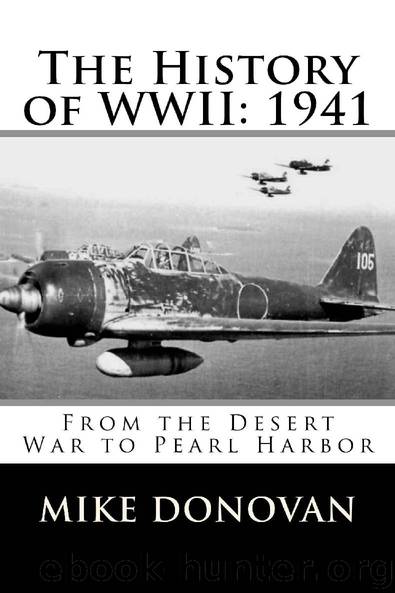
Author:Mike Donovan [Donovan, Mike]
Language: eng
Format: epub
Publisher: UNKNOWN
Published: 2018-06-27T23:00:00+00:00
The big strategic failure on a great day for the Japanese was not taking out the two US aircraft carriers in the Pacific Fleet, the Lexington and the Enterprise. These were the number one targets, not the battleships. It was an accident of flat out fortune that the flattops were out at sea.
The Lexington and Enterprise left Pearl Harbor at the end of November to beef up the island airfields of Midway and Wake. They became pure ‘carriers’, military ferries delivering Marine fighter planes to these two isolated outposts. L&E had completed their mission and were heading back towards Hawaii when news of the attack reached them. The Marine pilots that landed on Wake were in for a hot time of it there over the next three weeks.
The Japanese were very disappointed that no American carriers were sitting ducks at Pearl Harbor. It was goal #1 and it came up Zero. The Japanese pilots had to settle for the William Howard Taft vintage battleships sitting still around Ford Island.
But on the other hand, if both carriers had been there, maybe both the carriers and the battleships might not have been such sitting ducks.
When the carriers were home in Hawaii they were often still out on combat air patrol. They very seldom just sat there in the harbor. The same was true of the battleships. Even these old wagons were usually sallying somewhere. Even the battleships all bottled up that day wasn’t the norm. The Japanese were lucky to find any major arm of the fleet sitting so very still at anchor in the harbor.
When the US carriers patrolled around Hawaii they provided constant air cover for themselves and for the battleships. But with the carriers away on a distant mission, the battleships went into Pearl Harbor in order to gain the air protection of land-based Hawaiian air power. They were just sort of sitting there marking time until their big daddy carriers got back and then they could go out on patrol again.
So it's sort of a catch-22 for the IJN. If only the carriers had been there too like sitting ducks, the day would have been more glorious. That’s the standard version of history. But that isn't true because if the carriers had been there they wouldn't have been there. At least one would have been about and alert not too far from Honolulu. If the carriers had been back at Pearl, there was a better than 50-50 chance that most of the fleet would have been on patrol with a CAP. THE STARTING LINE-UP AT PEARL HARBOR
Now a look at Battleship Row: one ship at a time. This was the heart of the Pacific Fleet minus the carriers. Seven battleships sitting docked on the south side of Ford Island, in the middle of Pearl Harbor.
From west to east are California; followed by the oiler Neosho; followed by the four in-box formation battleships: the Maryland on the inside and the West Virginia on the outside; then the next two, side by side were the Tennessee on the inside and the Oklahoma on the outside.
Download
This site does not store any files on its server. We only index and link to content provided by other sites. Please contact the content providers to delete copyright contents if any and email us, we'll remove relevant links or contents immediately.
The Vikings: Conquering England, France, and Ireland by Wernick Robert(84606)
Ali Pasha, Lion of Ioannina by Eugenia Russell & Eugenia Russell(40385)
The Conquerors (The Winning of America Series Book 3) by Eckert Allan W(39136)
The Vikings: Discoverers of a New World by Wernick Robert(37051)
Cecilia; Or, Memoirs of an Heiress — Volume 1 by Fanny Burney(32726)
Cecilia; Or, Memoirs of an Heiress — Volume 2 by Fanny Burney(32090)
Cecilia; Or, Memoirs of an Heiress — Volume 3 by Fanny Burney(32068)
Empire of the Sikhs by Patwant Singh(23208)
The Secret History by Donna Tartt(19477)
Hans Sturm: A Soldier's Odyssey on the Eastern Front by Gordon Williamson(18727)
Cat's cradle by Kurt Vonnegut(15560)
Pimp by Iceberg Slim(14805)
Sapiens: A Brief History of Humankind by Yuval Noah Harari(14558)
Norse Mythology by Gaiman Neil(13576)
Talking to Strangers by Malcolm Gladwell(13559)
Leonardo da Vinci by Walter Isaacson(13526)
4 3 2 1: A Novel by Paul Auster(12628)
Underground: A Human History of the Worlds Beneath Our Feet by Will Hunt(12237)
The Radium Girls by Kate Moore(12189)
